Blog
If you would like to be notified about new blog posts, please subscribe below (no e-mail required).
To subscribe please disable any blocker add-ons for this webpage. Web push to iOS is currently not supported.
No effect of birth order on adult risk taking
Posted on Monday, Jun 03 2019
Research in personality psychology has explored many potential sources for the emergence of individual differences. One of them is birth order: according to Sulloway’s childhood niche hypothesis, later-borns develop a more pronounced propensity to take risks than firstborns, because "risk taking is a useful strategy in the quest to find an unoccupied niche". That is, in their competition for parents' limited resources, risk taking might be instrumental for later-borns to attract attention. But do such early experiences shape personality lastingly, potentially leading to stable adult differences in risk taking? We analyzed three datasets to address this question. First, we employed an exhaustive modeling approach (i.e., specification curve analysis) to analyze a large panel dataset with self-report data. Second, we analyzed a large set of self-report and behavioral measures from the Basel-Berlin Risk Study. Third, we analyzed historical data on explorers and revolutionaries. The analyses of our three-pronged approach speak with one voice and suggest a clear conclusion: there exists no effect of birther order on adult risk taking. For the full details, please see here.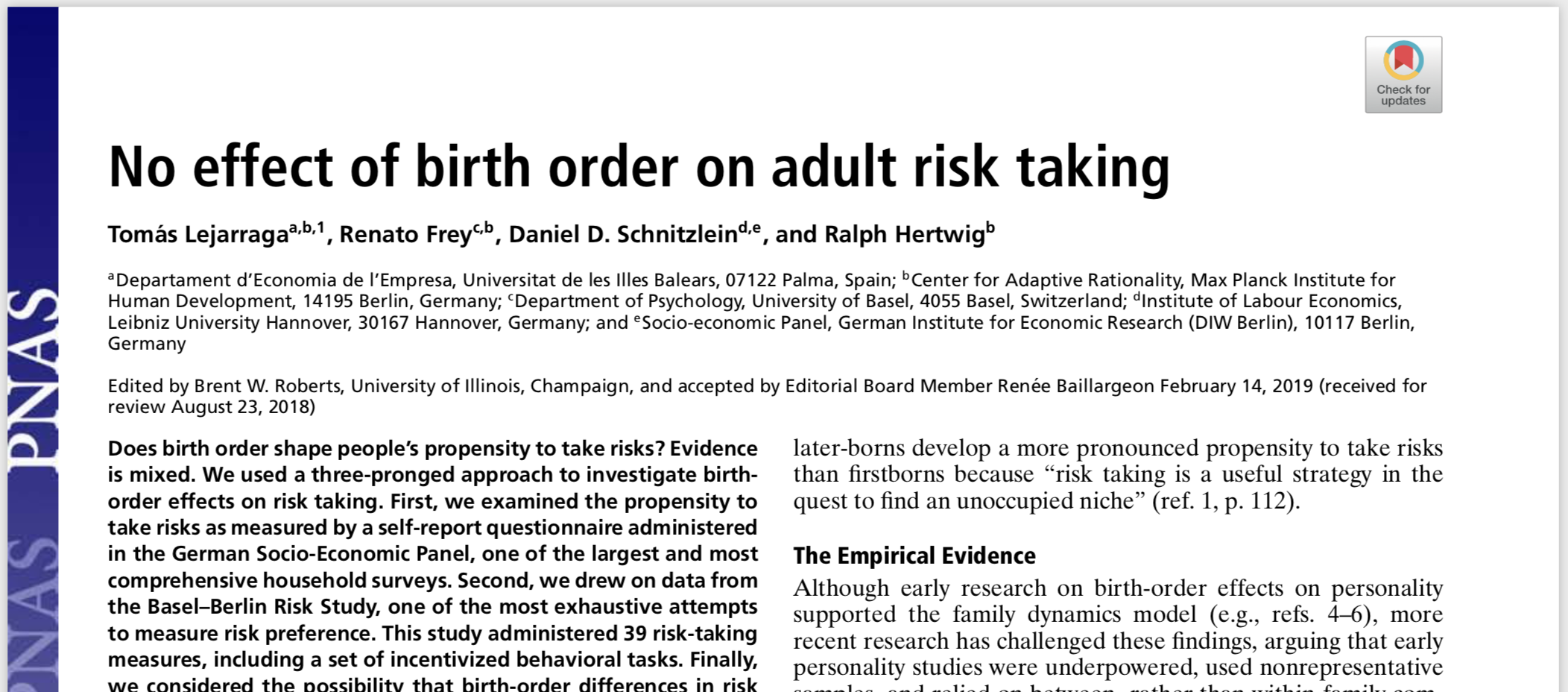
How well do people's subjective risk perceptions track objective risks?
Posted on Friday, Mar 15 2019
What drives people's risk perceptions in dynamic risk-taking environments? And how well do subjective risk perceptions in fact track the environments' objective risks? In a recently published paper, Oliver Schürmann, Tim Pleskac, and I have addressed these questions using the Balloon Analogue Risk Task (BART; for an online demo, click here). Specifically, using this task we aimed to map people's subjective perceptions of risks, as well as to examine how risk perceptions potentially change with growing task experience. We observed two main results: First, participants' subjective beliefs that a balloon will explode on a given stage of inflation (i.e., the conditional probability of an explosion when pumping once more) dramatically differed from the task's actual stochastic structure (i.e., shown by the dashed line in the figure below) – thus providing an explanation why people typically appear risk-averse in this task. Second, whether the first balloon exploded early (green lines) or late (red lines) had a substantial impact on participants' risk perceptions. Although these differences vanished by the end of the task, participants' risk-taking behaviors across the 30 trials still differed substantially. In sum, these findings highlight the important role of early experiences in the formation of subjective risk perceptions, and have direct implications for valid task designs in future developments of risk-taking measures. Read more.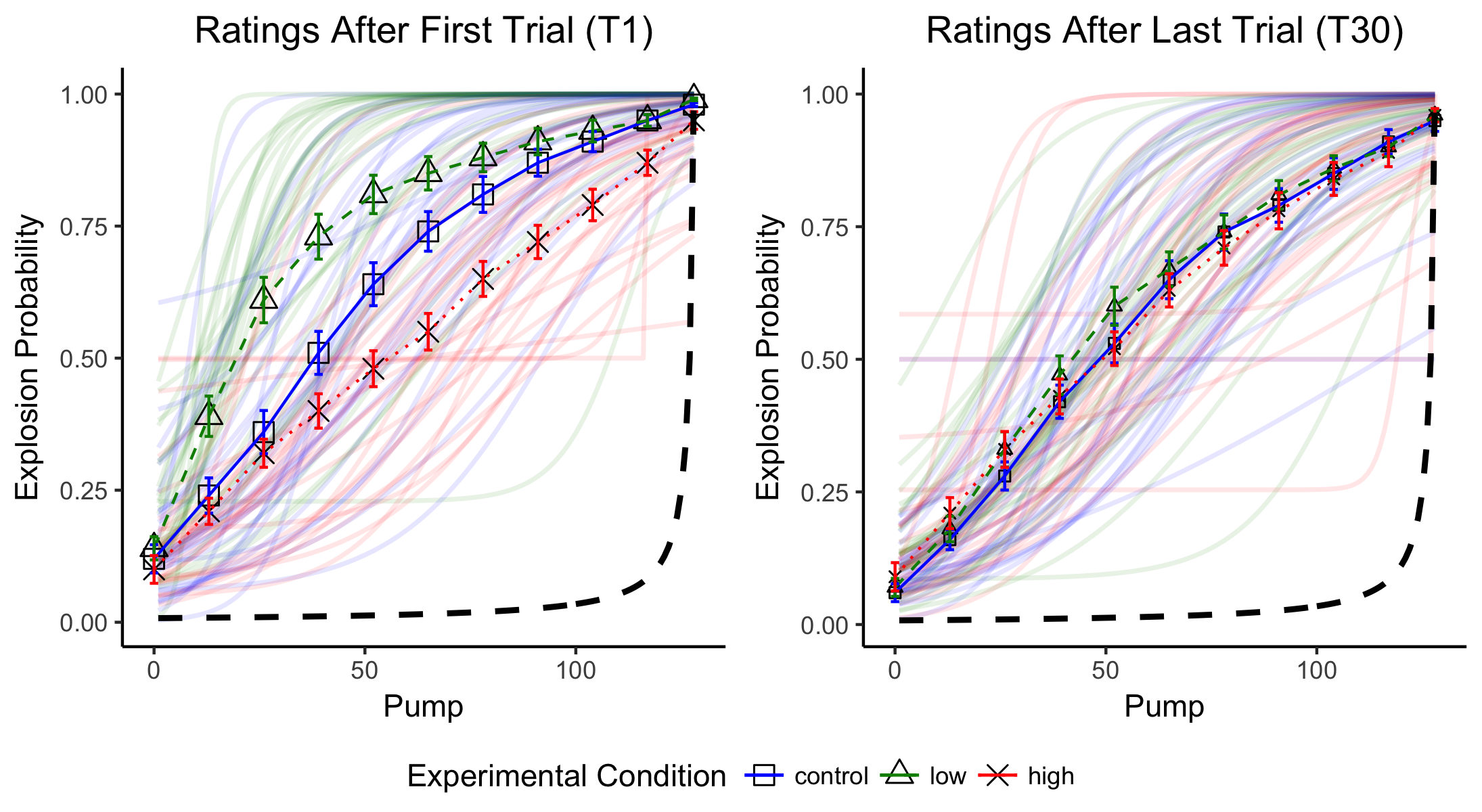
Schürmann, O., Frey, R., & Pleskac, T. J. (2019). Mapping risk perceptions in dynamic risk-taking environments. Journal of Behavioral Decision Making, 32, 94-105. doi:10.1002/bdm.2098
Research stay at Princeton University
Posted on Monday, Oct 22 2018
At the beginning of October I moved to the USA for a research stay at the Behavioral Science for Policy Lab at Princeton University. During the next few months, I will work together with Elke Weber to address questions regarding the generalizability of the construct risk preference (and potentially other personality dimensions) to sustainability- and energy-related decision making, as well as regarding the basic cognitive processes driving risk perceptions in these domains. Princeton has a thriving academic life, with numerous interesting talks at the various departments. Last but not least, the campus itself is phenomenal, including many beautiful libraries and quiet spaces to get a lot of work done!
New paper on surrogate decision making published in BMJ Open
Posted on Thursday, Aug 02 2018
If a patient is no longer able to express his or her treatment preferences (e.g., due to an accident or due to dementia), a surrogate may need to make medical decisions on behalf of this person. Such "surrogate decisions" are among the most difficult decisions under uncertainty that we have to make in our lives. So how to best make surrogate decisions?In our previous research (Frey, Hertwig, & Herzog, 2014) we found that different approaches to surrogate decision making (e.g., a patient-designated surrogate; all family members rendering a joint decision; etc.) do not differ substantially in terms of their "predictive accuracy". Therefore, in our most recent paper published in the British Medical Journal: Open (Frey, Herzog, & Hertwig, 2018) we investigated people's "procedural preferences". Specifically, how strongly do people endorse different approaches to surrogate decision making?

The figure above shows the results from two representative population surveys that we conducted in Germany and Switzerland. People reported their procedural preferences for six different approaches to surrogate decision making, either from the perspective of an incapacitated patient or from the perspective of a potential surrogate for an incapacitated family member. Fortunately, the procedural preferences of potential "patients" and "surrogates" were mostly aligned. Yet, endorsements for the different approaches varied markedly (see figure). These findings may have direct implications for clinicians and policy makers, as current legislations only provide for individualistic approaches. You can learn more about this topic under my research section on medical decision making and by downloading our paper with the detailed results.
Frey, R., Herzog, S. M., & Hertwig, R. (2018). Deciding on behalf of others: A population survey on procedural preferences for surrogate decision-making. BMJ Open, 8, e022289. doi:10.1136/bmjopen-2018-022289 | PDF
SNSF Ambizione project started
Posted on Tuesday, Jan 16 2018
Together with my new Ph.D. student Markus Steiner, I have started to work on an SNSF Ambizione project entitled "Mapping the ecology of risk taking: A test of the generalizability of the construct risk preference to real-life behaviors." During the next four years we will run a series of lab studies and ecological assessments to i) address open issues regarding the measurement of risk preference, ii) to better understand the ecology of risk-taking behaviors in the modern society, and iii) to evaluate the predictive validity of different measures of risk preference for important life outcomes. You can learn more about this project in my research section.